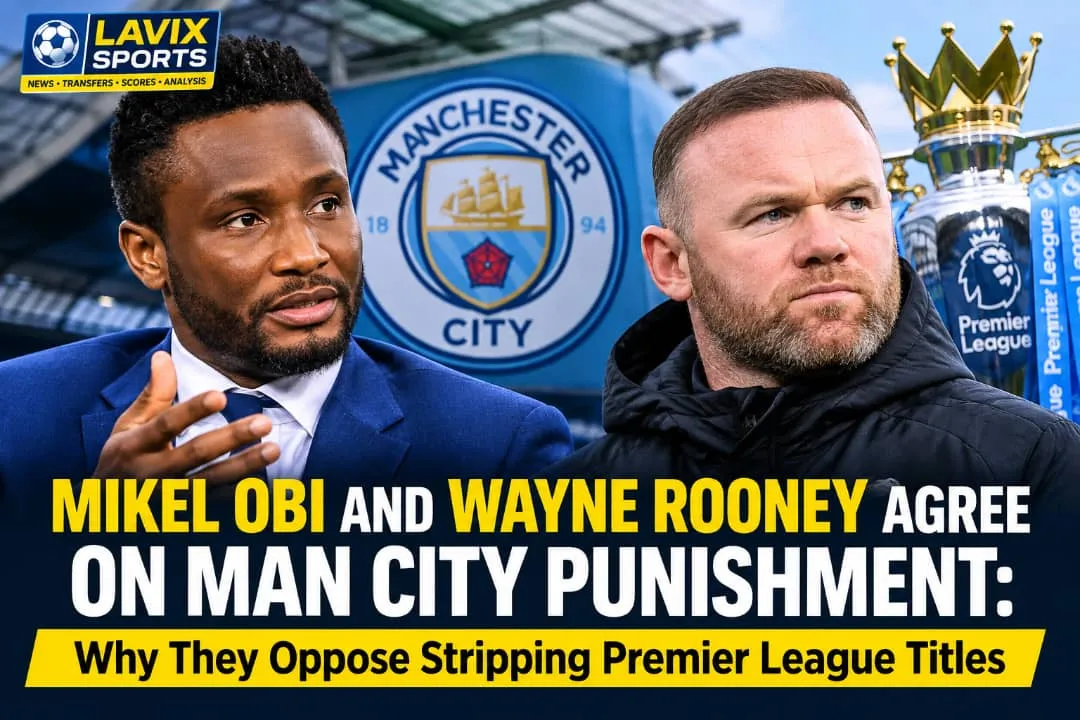
Mikel Obi and Wayne Rooney Agree on Man City Punishment: Why They Oppose Stripping Premier League Titles
John Obi Mikel and Wayne Rooney share a similar view on Manchester City's potential punishment. Here's why they oppose stripping Premier League titles and what could happen next.
The debate over Manchester City's potential punishment has taken another interesting turn after former Premier League stars John Obi Mikel and Wayne Rooney expressed similar views on one of the most controversial possibilities: removing City's past Premier League titles.
Manchester City were found guilty by an independent commission of serious breaches of Premier League financial rules covering the nine-season period from 2009/10 to 2017/18. The Premier League said the commission found that City had used agreements that misrepresented commercial arrangements, filed misstated accounts and breached spending limits. The commission also upheld most of the allegations concerning the club's cooperation with the investigation.
However, Manchester City have maintained their innocence and the process is not finished. The club has the right to appeal the commission's findings, while the separate question of sanctions remains to be decided.
That uncertainty has created a huge debate among former players and supporters.
And on one particular issue, Mikel and Rooney have found themselves on similar ground.
Rooney: "I wouldn't want" another Premier League medal
Wayne Rooney was part of the Manchester United team that narrowly missed out on the 2011/12 Premier League title to Manchester City.
United and City finished level on points, but City's superior goal difference meant Roberto Mancini's team won the championship after Sergio Agüero's famous stoppage-time goal against Queens Park Rangers on the final day.
More than 14 years later, Rooney has been asked about the possibility of City being stripped of historical titles if sanctions eventually include retrospective action.
His response was striking.
Rooney said he would not feel comfortable accepting another Premier League medal because United did not finish first on the pitch that season. He argued that the players competing for United had not won the title and that he would not want a medal awarded to him retrospectively.
At the same time, Rooney did not argue that Manchester City should escape punishment.
His suggested approach was much more focused on punishing the club going forward, including a severe sporting penalty and restrictions on spending.
That distinction is important.
Rooney's position is essentially that punishment for financial-rule breaches and recognition of what happened on the pitch are two separate questions.
Mikel Obi reaches a similar conclusion
John Obi Mikel has now offered a remarkably similar perspective from the Chelsea side of the old Premier League rivalry.
Speaking on The Obi One Podcast, Mikel said he would not want to be handed a Premier League title after another club had been stripped of it.
His reasoning comes from his experience as a player.
Mikel competed against some of Manchester City's strongest teams during his Chelsea career, facing players such as Yaya Touré, Fernandinho, Sergio Agüero and David Silva.
Rather than retrospectively claiming their trophies, Mikel argued that footballers compete against the team placed in front of them.
He also made an important distinction: if Manchester City are guilty of wrongdoing, he believes the club should face punishment. But he does not believe that necessarily means erasing the achievements of the players and managers who competed on the pitch.
That makes Mikel's argument more complicated than simply defending Manchester City.
He is effectively separating individual sporting performance from institutional responsibility.
Why Mikel and Rooney's argument matters
This is where the Manchester City case becomes much bigger than one football club.
Imagine a player spending an entire season training, travelling, playing 50 or 60 matches and eventually winning a league title.
Years later, an independent commission determines that the club breached financial regulations during the relevant period.
The question then becomes:
Should the sporting achievement be treated in exactly the same way as the financial misconduct?
There are arguments on both sides.
One argument is that financial rules exist to protect competitive fairness. If a club gained an advantage by breaching those rules, simply imposing a future punishment might not fully address the competitive consequences.
The other argument is that football matches were still played on the pitch. Players trained, managers prepared teams and matches were won and lost according to the results recorded at the time.
This is the tension behind the Mikel and Rooney comments.
What exactly was Manchester City found guilty of?
The case is often described simply as the "115 charges", but the underlying allegations cover several areas.
The Premier League's official statement says the independent commission found City guilty of serious financial breaches involving the period between the 2009/10 and 2017/18 seasons.
Among the findings were allegations involving commercial agreements, financial reporting and spending limits.
The commission also found that City breached duties relating to cooperation and good faith during the Premier League's investigation. The Premier League said three of four alleged groups of cooperation breaches were upheld.
Reports following the ruling have commonly described the outcome as 114 of the 115 charges being upheld, although the Premier League's public statement currently describes the findings by categories rather than publishing the full confidential decision.
That distinction is worth remembering when discussing the case online.
The full disciplinary process remains ongoing.
What punishment could Manchester City face?
This is another area where football fans should be careful with social-media claims.
There is no officially announced final punishment yet.
Premier League rules give the independent commission broad disciplinary powers. Possible sanctions can include fines, points deductions, suspension from league matches, player-registration restrictions, compensation and potentially expulsion from the Premier League.
That means headlines about Manchester City definitely being relegated, expelled or stripped of trophies should not be treated as confirmed outcomes.
The sanctions still have to be determined, and Manchester City can challenge the commission's decision through the appeal process. The Premier League has confirmed that an Appeal Board can uphold, vary or otherwise change the commission's order.
Why points deductions could be different from title stripping
A points deduction would mainly affect Manchester City's sporting position going forward.
For example, if a club receives a sufficiently large deduction, it could dramatically affect its league position or even lead to relegation.
That is different from rewriting football history.
Stripping a Premier League title would raise another set of questions:
- Which club should receive the title?
- Should runners-up automatically become champions?
- What happens to medals?
- What happens to Champions League qualification?
- Would domestic cups be affected?
- Should individual player records change?
- How should supporters' memories of those seasons be treated?
These questions help explain why the idea of retrospective title changes is so complicated.
Rooney's 2011/12 connection makes his position particularly interesting
Rooney's comments carry an unusual historical context because Manchester United were directly involved in one of the most dramatic Premier League title races in English football history.
United finished level on points with City in 2011/12 and lost the title on goal difference.
A retrospective change could therefore theoretically alter how that season is remembered.
Yet Rooney's position is that he would not want the medal.
For him, winning a championship means finishing the season as champions through the competition that actually took place.
That is a powerful reminder that football history is not only about official records. Players also attach personal meaning to how those achievements were earned.
Mikel's Chelsea perspective adds another dimension
Mikel's situation is different.
Chelsea were one of City's major Premier League competitors during the period in which City established themselves as one of English football's dominant teams.
Mikel won two Premier League titles with Chelsea, in 2009/10 and 2014/15.
He therefore experienced City's rise from the perspective of a rival player.
Yet his argument is that he would rather compete against the strongest possible opposition than inherit a title later because another club had been punished.
That does not mean he believes financial regulations are unimportant.
In fact, Mikel explicitly said Manchester City should face punishment if they are guilty.
His argument is about what kind of punishment should follow.
The bigger lesson for football
The Manchester City case could become an important reference point for how football authorities handle financial regulations in the future.
The Premier League introduced a new financial system for the 2026/27 season, replacing the previous Profitability and Sustainability Rules with the Squad Cost Ratio and Sustainability and Systemic Resilience rules. However, enforcement powers for breaches from earlier seasons remain relevant to ongoing cases such as City's.
That means the consequences of the City case could extend beyond one club.
Football authorities will have to consider how severe financial-rule violations should be punished, how quickly cases should be resolved and whether future sanctions need clearer guidelines.
For supporters, the biggest issue is trust.
Financial regulations only have meaning if clubs believe that breaking them carries meaningful consequences.
But punishment also needs to deal fairly with the players, managers and supporters who are connected to the sporting side of the game.
That is precisely why the views of Mikel Obi and Wayne Rooney have attracted attention.
What happens next?
The immediate focus is now on the legal and disciplinary process.
Manchester City have indicated that they intend to challenge the findings, while the sanctioning stage remains separate from the guilty verdict. The Premier League says the process remains ongoing and that further details will be published when permitted under its rules.
Until then, several possibilities remain open.
Manchester City could face a financial penalty, points deduction or other sporting restrictions. More severe sanctions are also available under the rules.
But there is an important difference between what is possible and what has actually been decided.
No final punishment should be treated as confirmed until the relevant authorities announce it.
Final thoughts
Mikel Obi and Wayne Rooney agree on one important principle: if Manchester City's financial-rule breaches ultimately result in punishment, that does not automatically mean former rivals should receive trophies retrospectively.
Rooney's position is shaped by his experience of the 2011/12 title race, while Mikel's comes from years of competing against City's leading players with Chelsea.
Their argument does not remove the seriousness of the financial case.
Instead, it raises a broader football question:
Can a club be punished for what happened behind the scenes without completely rewriting what players achieved on the pitch?
That question may remain part of the Manchester City debate for years.
For now, the most important thing for supporters is to separate the confirmed findings from the possible sanctions. Manchester City's case has reached a major stage, but the final consequences — and any successful appeal — have yet to be settled.
Read more
Found an error? Contact our editorial team.